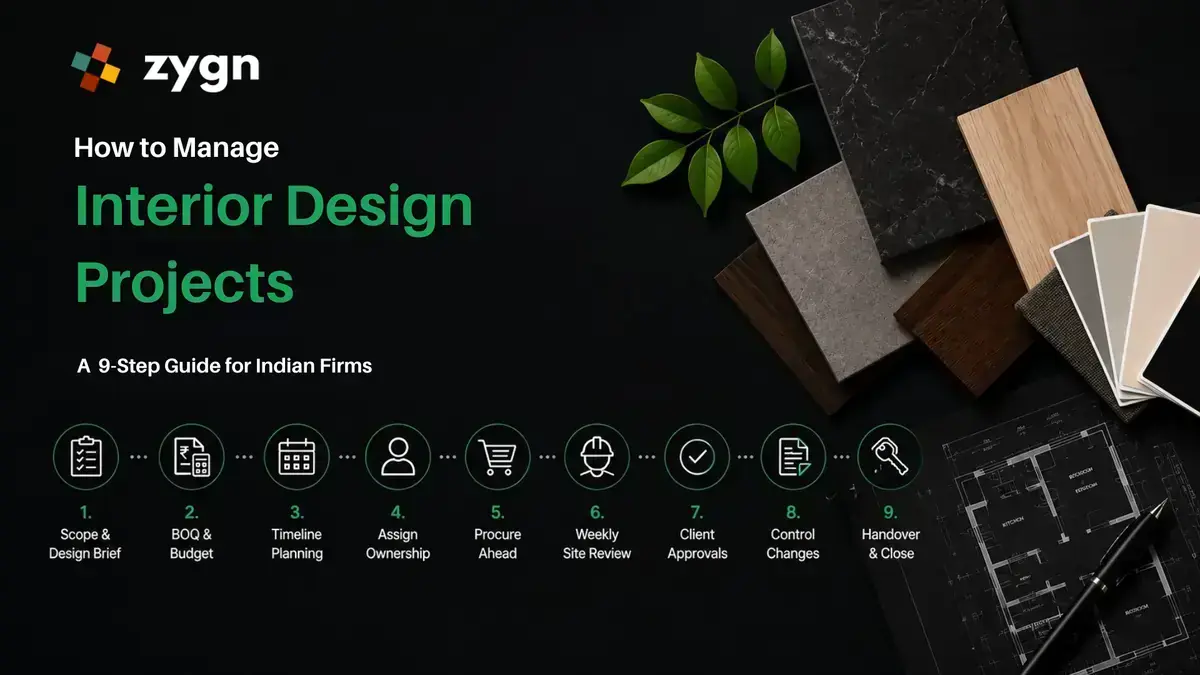
Managing an interior design project means controlling seven things: scope, design stages, BOQ, procurement, site execution, client approvals and billing. The most reliable method is a single system where each stage feeds the next the nine steps below cover the full cycle from design sign-off to handover, for residential and commercial projects alike.
Step 1 - Freeze the scope and design brief
Get written sign-off on drawings, finishes and inclusions before execution begins. This is the single highest-leverage act in the whole project: every dispute you'll ever have traces back to something that wasn't frozen. Walk the client through layouts, the finish schedule and what is explicitly excluded, then record their approval. From this point, every "small change" is a documented change order with a price and a time impact not a favour.
Step 2 - Build the BOQ and budget
Convert the approved design into a room-wise Bill of Quantities with quantities, rates and GST. The BOQ is three documents in one: your client quotation, your purchase plan and your cost baseline. Build it room by room, specify materials per line ("Merino 1mm laminate, matt" - not "laminate"), and get the final version signed off. A wrong quantity here becomes a wrong quote, a wrong PO and a margin leak. (
Step 3 - Create a stage-wise timeline
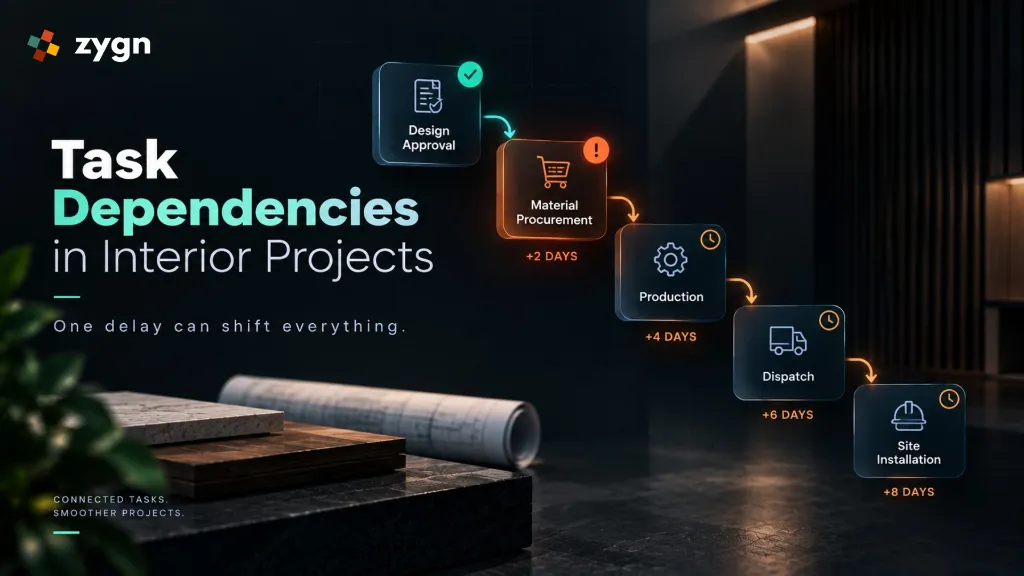
Sequence site works in their natural dependency order - civil and demolition, electrical and plumbing, false ceiling and POP, carpentry and modular, finishes, soft furnishing - with buffer for material lead times. The timeline's job is to answer one question every week: what must be ordered, delivered or finished for next week's work to start on time? Modular and imported items have the longest lead times; schedule those orders first.
Step 4 - Assign ownership
One project lead, one site supervisor per site, and clear vendor responsibilities in writing. When everyone owns everything, nobody owns anything: the classic failure is three people each assuming someone else ordered the hardware. Publish the ownership map to the whole team including the client, who should know exactly whom to call and keep decision authority (approvals, payments, changes) explicit.
Step 5 - Procure against the BOQ, ahead of each stage
Raise purchase orders from BOQ quantities with delivery dates matched to the stage schedule never from memory or WhatsApp messages. Late tiles stall a site for a week; a missing hardware box stalls handover. Track deliveries, not just orders: what actually arrived, in what condition, at which site. Every purchase should trace to a BOQ line so nothing is bought twice, and nothing off-budget slips through. (
Step 6 - Run a weekly site review
Photos, percent-complete per stage, issues and next week's plan in a shared system, not in one person's WhatsApp. The weekly review is where slippage is caught while it costs days, not weeks. Keep the format identical across projects so a multi-site review takes thirty minutes: each site's supervisor reports against the same five questions, and every issue leaves the meeting with an owner and a date.
Step 7 - Document every client approval
Material samples, colour changes, additional work approved in writing with cost and time impact stated before work proceeds. Verbal approvals are the most expensive words in this business: the client remembers approving the look, not the price. A simple discipline - photograph the sample, state the delta, get a written yes - converts your biggest source of disputes into a clean record both sides trust.
Step 8 - Control scope creep
Log every change request against the BOQ, reprice it, and get sign-off before executing. Unpriced changes are where project margins go to die not in one big change but in fifteen small ones nobody billed. A change log tied to the BOQ shows the client the running total of additions, which itself dampens casual change requests. Review the change log in every weekly review alongside progress.
Step 9 - Close properly
Joint snag-list walk-through, rectification, then a handover file: warranties, maintenance notes, final BOQ and payment summary. The snag walk should be scheduled, not improvised room by room, with the client, items photographed and dated. A clean, documented handover does two things: it ends the project (instead of letting it fade into months of callbacks), and it is your strongest referral asset.
The two failure points to watch
Scope changes and procurement. Both are controllable: reprice every change in writing, and raise purchase orders from BOQ quantities with delivery dates tied to the site schedule. Industry growth is making this harder, not easier India's interior design market is projected to nearly double from USD 35.5 billion in 2026 to USD 65 billion by 2031 (Mordor Intelligence), which means more parallel projects per firm and less room for manual tracking.
Tools: spreadsheet vs software
A spreadsheet works for one project at a time; it breaks at 3+ parallel sites because BOQ, POs, site updates and payments live in different files. Interior project management software keeps them on one record the timeline knows the BOQ, the BOQ knows the POs, and the weekly review runs off live data. (