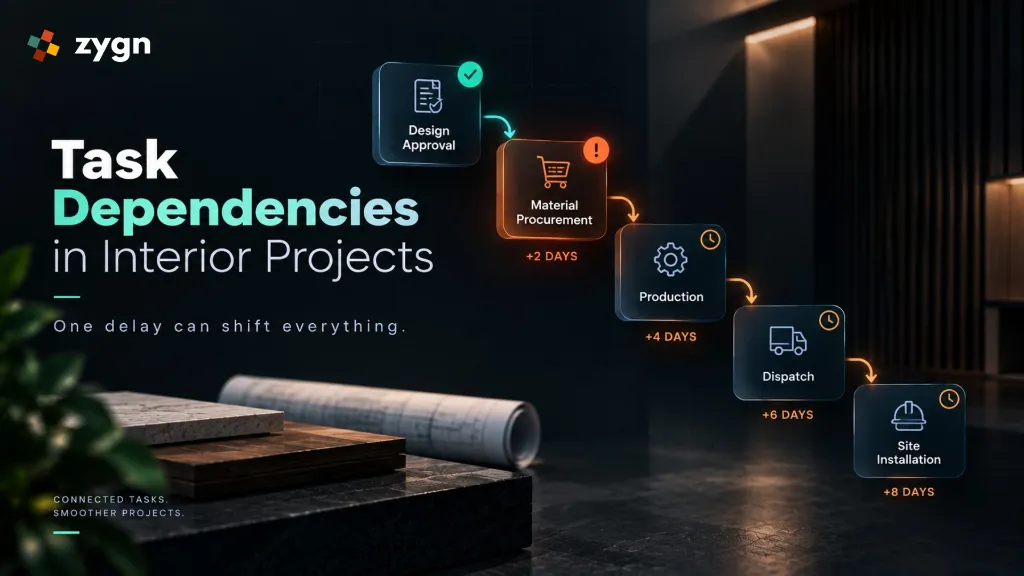
A two-day delay in material procurement rarely stays a two-day delay. By the time it reaches the site installation team, it's often grown into a week because production couldn't start until the material arrived, dispatch couldn't happen until production finished, and installation couldn't begin until dispatch was complete. This is what task dependencies in interior design projects do: they turn a small, isolated delay into a chain reaction across the entire project timeline.
What Are Task Dependencies?
Task dependencies are the connections between project activities where one task's completion determines when the next task can begin. In interior design and construction projects, most activities don't happen in isolation: they follow an execution sequence where each step relies on the one before it.
A typical sequence for managing dependencies in interior fit-out projects looks like this:
If design approval is delayed by three days, material procurement can't start on schedule either. Every task after it shifts by roughly the same amount, unless something is done to recover the lost time.
Why Dependency Chains Matter More Than Individual Task Delays
Most project tracking focuses on individual tasks: is this task on time or not? But in a project built on dependencies, the more important question is: what does this task's delay do to everything downstream of it? Understanding this delay cascade project management reality is crucial for maintaining timeline integrity.
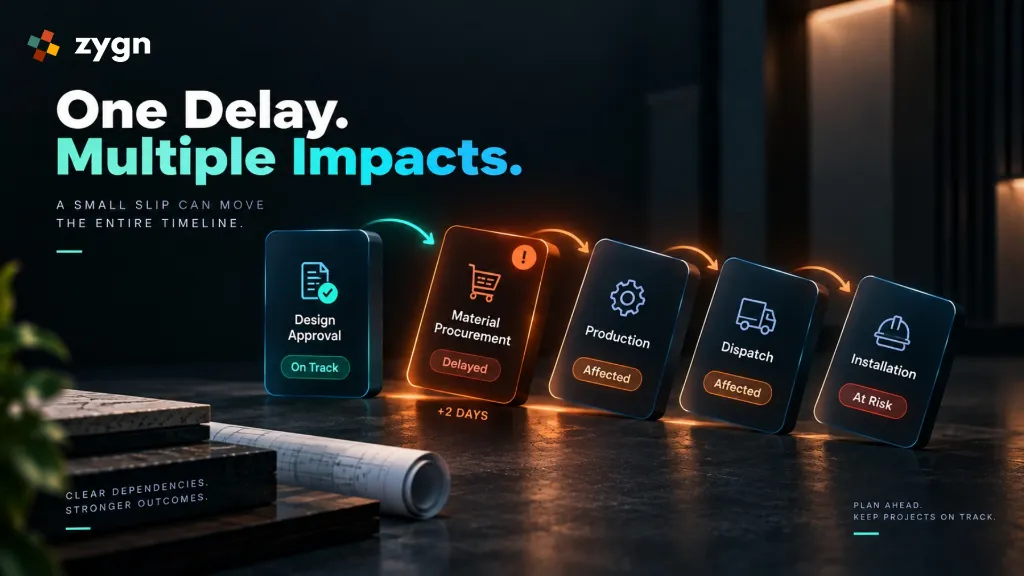
This distinction matters because:
- The same delay has different consequences depending on where it happens. A two-day delay in a task with no dependents might not affect the project deadline at all. The same two-day delay in an early-chain task like design approval can push back every subsequent activity.
- Dependency delays compound. Each task in the chain often has its own buffer or lead time built in. When a task starts late, that buffer shrinks or disappears for everything after it.
- Without mapped dependencies, the connection isn't visible until it's a problem. Teams often don't realize task A was blocking task D until task D is already late, by which point there is little room left to recover.
Common Dependency Chains in Interior and Construction Projects
To implement effective project risk management interior design protocols, managers must recognize standard dependency pathways across interior fit-out stages.
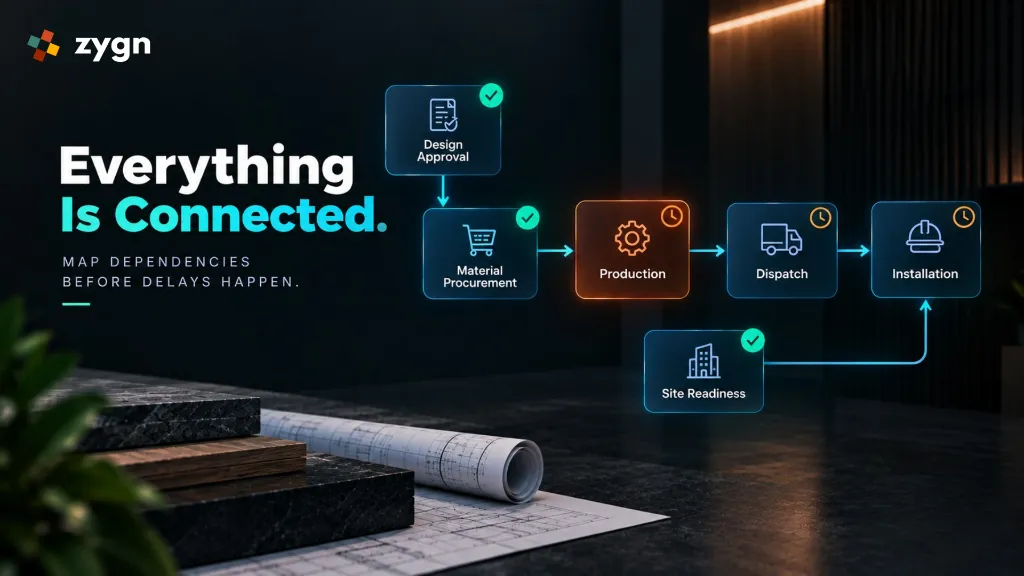
| Sequence | Example Dependency | What a Delay Here Affects |
|---|---|---|
| Design Approval → Material Procurement | Client sign-off on material selection before ordering | Pushes back every task that follows |
| Material Procurement → Production | Materials must arrive before fabrication begins | Delays production start date directly |
| Production → Dispatch | Items must be finished before they can ship | Delays site delivery date |
| Dispatch → Site Installation | Materials must arrive on site before installation crew can start | Delays installation and, often, the client handover date |
| Site Readiness → Installation | Site must be prepared (electrical, civil work) before installation | Can block installation even if materials have already arrived |
How to Identify Project Risks Before They Become Delays
Dependency mapping construction workflows show how a delay will travel through a project. Learning how to identify project risks before they cause delays is about spotting early warning signals before work comes to a standstill.
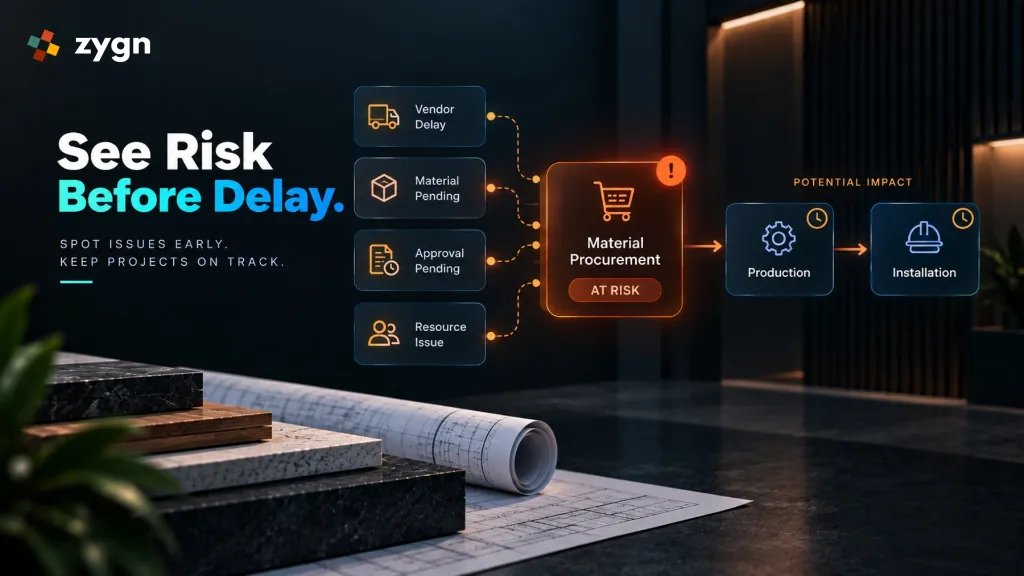
Common project risk factors in interior and construction work include:
- Material delays
- Design approval delays
- Site readiness issues
- Vendor delays
- Production delays
- Resource availability
- Client approval pending
- Dependency-related delays inherited from an earlier task
Tracking these risks against the specific tasks and dependencies they affect through proactive interior project risk tracking means a manager can see, for example, that a pending client approval on a design task is likely to delay three downstream activities, allowing them to manage that conversation with the client before the deadline is missed.
Practical Ways to Manage Dependency Risk
1. Map Dependencies Before the Project Starts
Identify which tasks depend on which others as part of the initial project plan, not as an afterthought once a delay has already occurred. This makes the impact of any future delay visible from day one.
2. Build Checklists Into Dependent Tasks
Attaching a checklist to a task (such as confirming material received at site, verifying site measurements, and checking quality before marking an installation task complete) reduces the chance that an incomplete step gets missed and quietly becomes a dependency risk for the next task in the chain.
3. Review Risk Alongside the Timeline, Not Separately
Risks are most useful when they're visible next to the task and dependency they affect, rather than tracked in a separate document that requires manually cross-referencing against the schedule.
4. Communicate Downstream Impact Early
Once a delay is identified in an early-chain task, flag which downstream tasks and team members are likely to be affected, so procurement, production or site teams aren't caught off guard when their start date shifts.
How zygn Supports Dependency and Risk Management
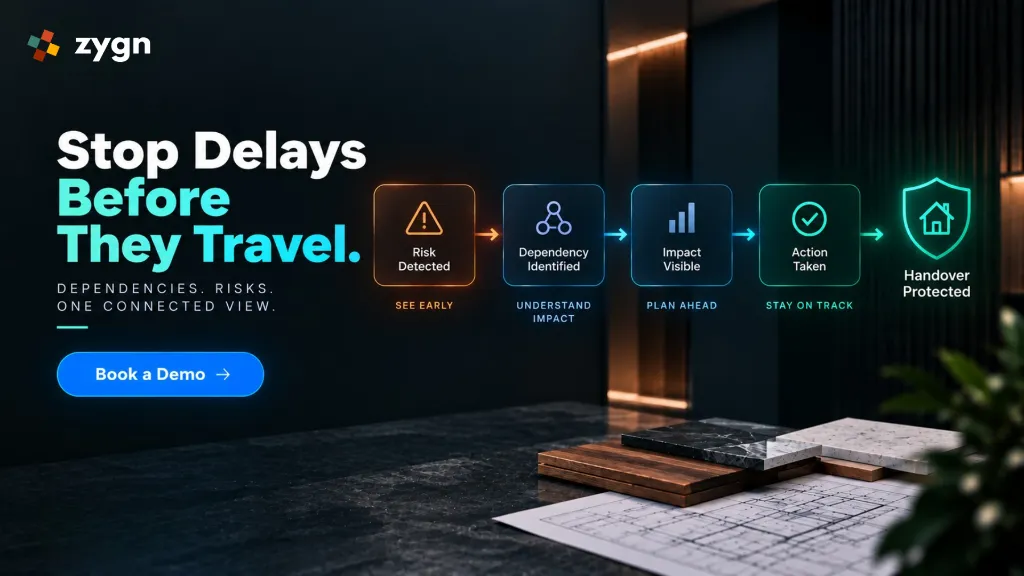
zygn's Project Timeline Management lets interior and construction teams map task dependencies directly into the project plan, so the downstream impact of a delay in one activity (such as design approval or material delivery) is visible immediately rather than discovered after the fact. Checklist-based task execution and project risk tracking work alongside these dependencies, giving managers a way to catch issues like material delays, vendor delays, or pending approvals while the project is still in progress.
This sits naturally alongside zygn's project management capabilities and connects to related workflows such as procurement management and BOQ management, as many of the dependency risks in an interior project originate in these upstream activities.
Prevent Delay Cascades on Your Next Project
A delay rarely stays contained to a single task; it travels through every activity that depends on it. With zygn, interior and construction teams can map task dependencies, track project risks, and see the downstream impact of a delay before it reaches the client handover date.